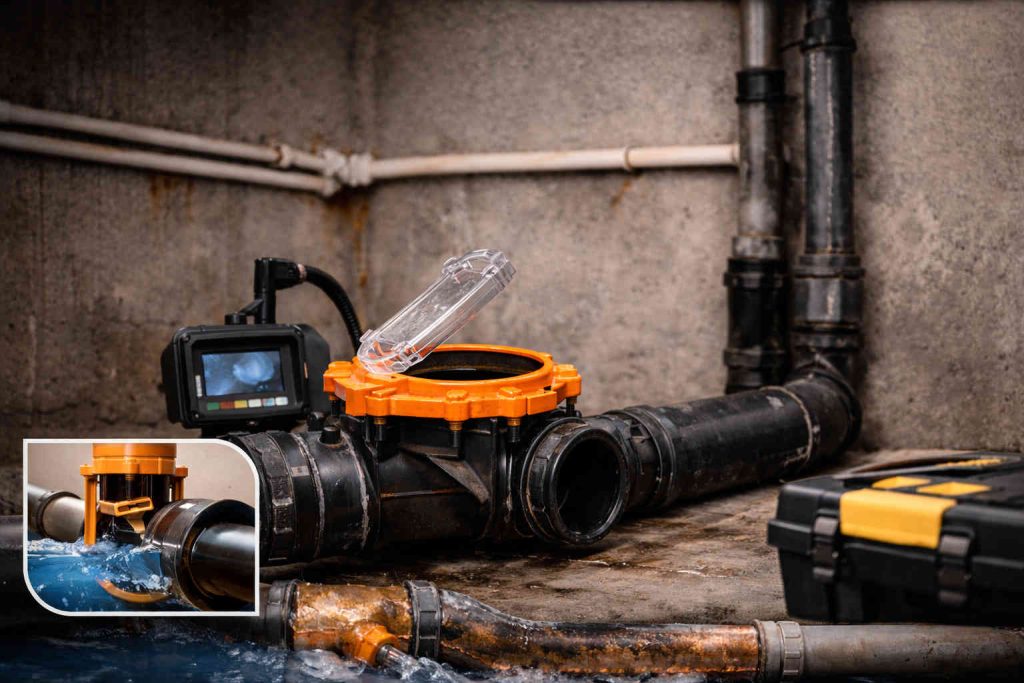
Backwater valve inspection: safety and prevention
Why is backwater valve inspection essential?
Backwater valve inspection is a crucial step in protecting your property against sewer backups. Too often overlooked, this device plays a fundamental role in keeping your home safe.
A backwater valve acts as a barrier: it prevents wastewater from flowing back into your pipes when the municipal system is overloaded, particularly during heavy rainfall, snowmelt, or sewer blockages.
Without regular inspection, this mechanism can become stuck, clogged, or lose efficiency, significantly increasing the risk of major damage.
The key role of the backwater valve in your system
The backwater valve is installed on the main sewer line. Its operation is based on a simple principle: it allows normal wastewater flow to the sewer but automatically closes in the event of backflow.
Specifically, it protects against:
- Sewer backups in the basement
- Infiltration of contaminated water
- Damage to floors, walls, and foundations
- High cleaning and decontamination costs
A defective or poorly maintained valve quickly becomes a point of vulnerability.
Risks of an uninspected backwater valve
Failing to perform a backwater valve inspection can lead to serious consequences, both financially and health-wise.
- Sewer backup
The primary risk is wastewater backing up into your property. This can happen quickly and cause significant damage.
- Contamination and health risks
Sewage contains bacteria, viruses, and harmful contaminants. Infiltration into your basement can create an unsafe environment.
- Insurance claim denial
Some insurance companies require regular maintenance and certified inspections of the valve. In case of negligence, your coverage could be compromised.
- Non-compliance with municipal regulations
Many municipalities in Quebec enforce strict standards regarding the installation and maintenance of backwater valves.
How often should a backwater valve be inspected?
A preventive inspection is recommended at least once per year, ideally:
- In the spring (snowmelt)
- In the fall (before heavy rains)
However, some situations require more frequent inspections:
- Homes with finished basements
- High-risk backflow areas
- Older installations
- Presence of trees (roots may obstruct pipes)
What does a professional inspection include?
A backwater valve inspection performed by a qualified professional is much more than a simple visual check.
Here is what is typically inspected:
- The overall condition of the valve
- Proper operation of the mechanism (opening/closing)
- Presence of debris or obstructions
- System watertightness
- Access to the valve (ease of maintenance)
- Compliance with current standards
In some cases, a camera inspection may be used to assess the condition of the pipes.
Backwater valve maintenance: a simple but crucial step
In addition to inspection, regular maintenance of the backwater valve is essential to ensure its effectiveness.
Best practices:
- Clean the valve at least once per year
- Remove residue (grease, sand, debris)
- Check proper flap movement
- Ensure nothing obstructs closure
Improper maintenance can prevent the valve from closing properly during a backflow event.
Inspection and compliance: an often underestimated issue
In Quebec, many municipalities require the installation of backwater valves, especially in basements.
However, beyond installation, compliance also depends on maintenance and inspection.
Why it matters:
- Compliance with municipal regulations
- Maintaining valid home insurance coverage
- Proof of maintenance in case of a claim
- Protection of your property value
A certified inspection can serve as proof in the event of a claim.
Signs your backwater valve requires urgent inspection
Certain warning signs should alert you immediately:
- Unusual sewer odors
- Slow draining
- Unusual plumbing noises
- Partial water backup
- History of sewer backups
In these cases, prompt action is recommended to avoid a critical situation.
Why hire a professional?
Although some maintenance can be performed by the homeowner, a professional backwater valve inspection offers several advantages:
- Technical expertise
A professional can detect issues that are invisible to the naked eye.
- Specialized equipment
Camera inspection, specialized cleaning tools, performance testing.
- Report and certification
An official document can be provided, useful for insurance or municipal compliance.
- Preventive intervention
Correction of issues before they become costly.
Preventing sewer backups: a comprehensive approach
Backwater valve inspection is part of a broader prevention strategy.
Other recommended measures:
- Install a sump pump system
- Avoid disposing of grease or waste in drains
- Maintain drainage pipes
- Check downspouts
- Ensure proper exterior drainage
A proactive approach significantly reduces risks.
An essential inspection for your peace of mind with Roland Bourbonnais Ltd.
Backwater valve inspection is much more than a simple check: it is an essential protective measure against sewer backups, property damage, and health risks. Regular maintenance, certified inspections, and compliance with standards are key to ensuring the safety of your property. Don’t let a simple component become the cause of a major incident.
For professional and compliant service, you can rely on Roland Bourbonnais Ltd., a company recognized for its expertise in plumbing and drainage system inspections. Their team offers comprehensive services including backwater valve inspections, preventive maintenance, camera inspections of pipes, and detection of sewer system issues. With thorough inspections and specialized equipment, they help prevent backups and ensure your system meets all requirements. Have your backwater valves inspected today and make sure your system works properly when you need it most.